Showing posts with label #botball. Show all posts

Saturday, December 7, 2019

After School Botball

We had our first meeting after school on Thursday. I cannot say enough about how much I love teaching students #botball curriculum. Our group is a mixture of 3rd through 6th grade students, and no matter their grade level, they all showed the same excitement in getting their robot to move forward few inches. Using text-based programming is a challenge but empowers the students. It leaves no doubt that these students are coders. I can't wait to see where this takes them. You can learn more about the Junior Botball Challenge program for elementary students and Botball program for middle school and high school students below.

https://www.kipr.org/jr-botball/about

https://www.kipr.org/botball


Sunday, December 1, 2019

Junior Botball Fun! Love these robots!

I became involved in Junior Botball Challenge (JBC) in 2017. The Idaho STEM Action Center offered a grant to receive training and robots. My colleague, Gina Kwid, joined me on this adventure. We worked with students in 3rd-5th grade after school in the 2016-2017 and 2017-2018 school year. When I left the school for my fellowship, Gina continued the program at Galileo STEM Academy during the 2018-2019 school year and added Botball for students in 6th-12th grades. When I returned to the classroom after my fellowship, I ended up in a new classroom, new school, and new district. My administrator supported me in starting up JBC at our school, and the Idaho STEM Action Center offered a grant that allowed me to refresh my skills with professional development and get robots to use with my students. My colleague, the school Librarian, Linda Reuling, joined me on this
adventure.


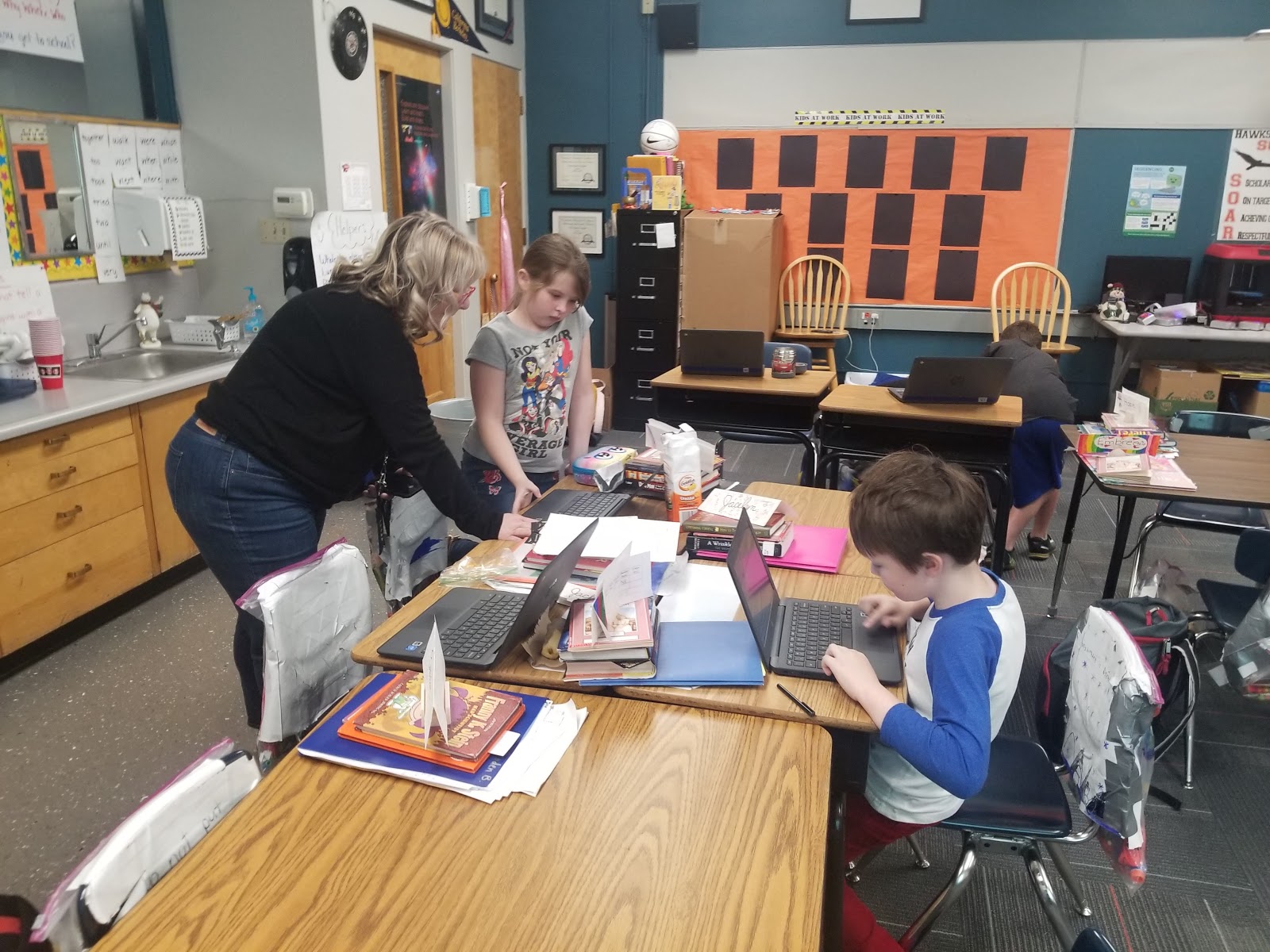
Since our training in early October, I have been using the robots with my 3rd grade students. Teaching a classroom full of students by myself was a little challenging, especially at the beginning. These students had not faced such challenging work it seems. Many of them did not know how to problem solve other than waiting for me to assist them. In order to maximize their time coding rather than waiting for me to help them, I reinforced my classroom policy of "Ask three before you ask me." Since starting in October, the students have worked through a variety of activities in the JBC Curriculum. Initially, it took a significant amount of time for students to connect to their robot or wallaby. It's important to know it will get better. Our class worked with the robots at least twice a week to keep the skills fresh and growing.


Now, the majority of students are able to get connected without assistance. In addition, most connecting issues can be resolved by other students. This frees me up to work with students that are having bigger issues with their programming or understanding an activity. With the skills developed, I can now manage an entire class of 3rd grade students programming at the same time. As students became more adept at completing activities, I gave them the challenge of designing their own robot challenges. Seeing their smiles was all I needed to know they were ready to do a little less guided exploration. They have the basic skills that would allow them to test ideas they may have been wondering about.


Students had to write the instructions for their challenge. There were activities posted on the whiteboard from the JBC curriculum for examples. After writing their instructions, students had to code their own challenge before they could post it for others to complete. In addition, before they could post their instructions, they had to have them checked for spelling and other possible errors. We are currently still working on this challenge. Students who have completed their own challenge can continue experimenting with the robots or try other challenges created by their classmates.


In December, our after school group starts and will serve 3rd - 6th grade students. I'm excited to see where all of the students are at on their programming, critical thinking, and problem solving by the end of the school year.



Sunday, February 11, 2018

2018 Space Exploration Educators Conference

A team of teachers from our school wrote grants to attend the 2018 Space Exploration Educators Conference (SEEC). We had all taken part in the NASA Microgravity University for Educators (#NASAMgUE) last year. During that experience, we traveled to NASA Johnson Space Center for profressional development and testing of our students' deployment device (https://microgravityuniversity.jsc.nasa.gov/about-mgue.cfm). During that amazing week, we did not have any time to visit Space Center Houston, but we did learn of the SEEC conference. We quickly made plans to return to Houston and attend the conference as a team. We all took part in writing grants for travel and scholarships for registration costs. In the end, we had enough funds to fully cover the costs of the trip.  Our school district supported us by providing substitutes for the team to have time to attend the conference. Our school supported us by managing the grant funds and helping us secure all the necessary travel arrangements. The PTA was even ready to cover our registration costs; however, that wasn't necessary because we had additional grant funds come in to cover those costs as well.


In January we were able to register for sessions. We were all amazed and excited about the fantastic sessions offered and the tours available at NASA Johnson Space Center.  It really was difficult to choose. Nevertheless, we complete our session choices, reserved our hotel and rental car, and before we knew it, it was time to board the airplane to Houston. After not having any time to visit Space Center Houston, our entire conference was based in the museum. It was amazing! Session were taught by knowledgeable and experienced educators, as well as, industry professionals who have worked in the space industry. Gina Kwid and I presented for one session sharing about our NASA MgUE experience, the robot components we used in the deployment device, and teaching educators how to code those same robots using C++.  The entire conference was an amazing individual experience, team-building experience, and something I will never forget. 


I also became part of the Space Educator Expedition Crew on team Destiny which is a phenomenal opportunity for educators. "Educators from around the country are collaborating to prepare students for 21st century science, technology, engineering and mathematics (STEM) careers through Space Center Houston’s inaugural Space Exploration Educator Crew.  Space Center Houston launched the program in 2017 to help meet a nationwide need to prepare students for STEM careers and an equal need for extraordinary teacher leaders to inspire students. The crew aims to empower teachers to build leadership competencies by creating innovative STEM programs for their students, schools and communities." For more information or to apply for next year visit https://spacecenter.org/teacher-programs/space-exploration-educator-crew/.


Amazing opportunities await all attendees at Space Exploration Educators Conference (https://spacecenter.org/teacher-programs/teachers-seec/)!

Made It to the Fall Break

 Wow! What a year! I'm not just talking about 2020, but I am also referring to last school year 2019-2020 and the current school year 20...